
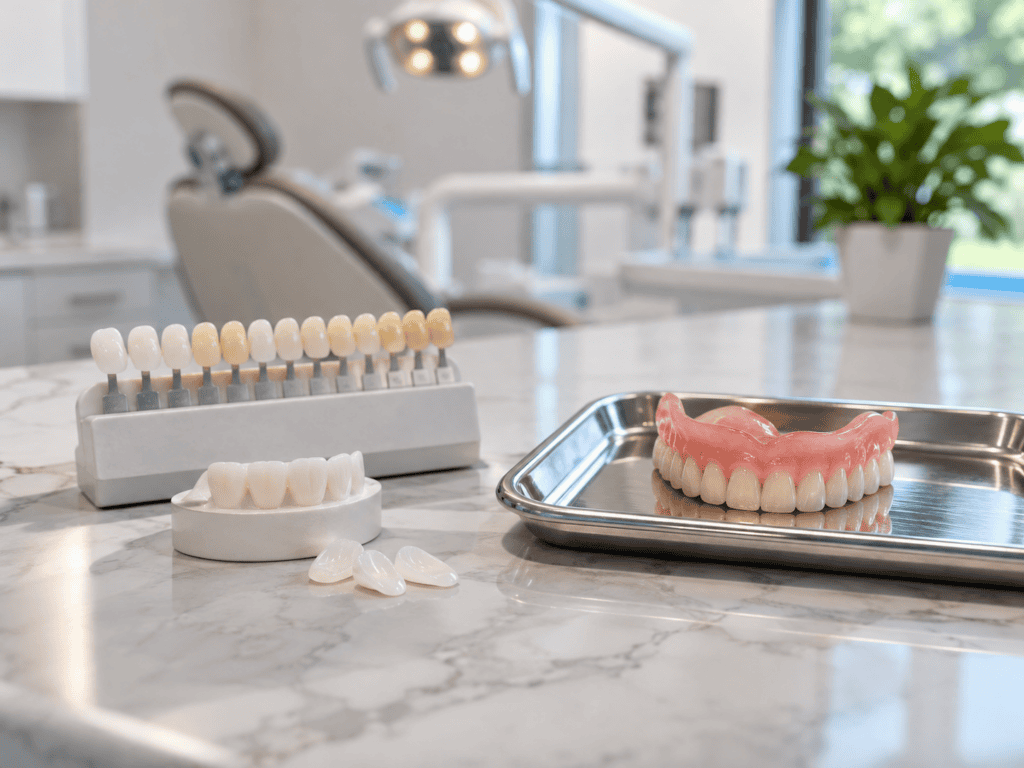
Veneers improve the appearance of teeth you still have. Dentures replace teeth that are missing. If you are comparing veneers vs dentures, start with what needs to change in your mouth before comparing prices.
If you want to change the color or shape of healthy teeth, veneers may be an option. If you have gaps from missing teeth, you need to discuss a replacement such as a denture, bridge, or implant. Some people have both cosmetic concerns and missing teeth, so their treatment plan may involve more than one approach.
Veneers and dentures at a glance
| What to compare | Dental veneers | Dentures |
| Main purpose | Change the appearance of existing teeth | Replace missing teeth |
| What they attach to | The front surface of natural teeth | A base supported by gums, teeth, or implants |
| Typical options | Porcelain or composite | Partial, complete, or implant-retained |
| Removal at home | Conventional veneers stay attached | Conventional dentures are removable |
| Pricing unit | Usually per tooth | Usually for a partial denture or an arch |
| Important requirement | Teeth and gums suitable for cosmetic treatment | A design that suits the gaps and remaining tissues |
What veneers can and cannot change
Dental veneers cover the front of natural teeth. They can change the appearance of discoloration, uneven shapes, small chips, or certain spaces between teeth. A veneer needs a tooth to attach to; it cannot replace a tooth that is completely missing.
Porcelain veneers are made to fit the teeth and are bonded into place. Composite veneers use tooth-colored resin. The preparation, appointment schedule, and maintenance differ between materials. Our comparison of composite and porcelain veneers explains those differences.
Teeth need to be assessed before cosmetic treatment. Decay, gum disease, or significant structural damage may need another approach first. A badly weakened tooth might need a crown rather than a veneer. For a small chip, dental bonding may be a more limited treatment worth discussing.
Veneer preparation can involve removing enamel, making the change irreversible. Ask how much preparation is proposed and whether a less extensive treatment could address your concern. The answer may differ from one tooth to another.
What dentures replace
Dentures replace missing teeth and some of the appearance of the surrounding gum tissue. They can help restore chewing and speech as well as the look of a smile, although using a new denture usually involves an adjustment period.
Partial dentures
A partial denture replaces several missing teeth while other natural teeth remain. Its design depends on where the gaps are and the condition of the teeth that help support or retain it. It does not require removing every tooth in that arch.
Complete dentures
A complete denture replaces all the teeth in an upper or lower arch. A conventional denture is fitted after the tissues have healed following tooth removal. An immediate denture is prepared in advance so it can be placed when the teeth are removed. Changes during healing can mean later adjustments, relining, or a replacement denture.
Implant options
Some dentures attach to implants for added retention and are removed by the patient for cleaning. Other implant-supported replacements are fixed and are removed by a dental professional. Ask which design is being proposed; “implant teeth” can refer to different types of restoration. Our dental implants vs dentures article looks more closely at replacement options.
Veneers vs dentures cost
The prices are usually quoted differently. Veneers are commonly priced per tooth. Dentures are commonly quoted as a partial denture or for an upper or lower arch. Comparing one veneer with one denture does not tell you what it would cost to address your whole situation.
For national context, CareCredit’s veneer cost guide lists an average of about $1,455 for a single veneer, with a reported range of $1,020 to $2,506 across veneer types. Those figures are national estimates, not Tolley Dental prices. Material, preparation, and the number of teeth treated all affect a personal estimate.
For dentures, the total depends on the design and whether the plan includes extractions or implants. An immediate denture may also involve later work as the tissues heal. A lower advertised denture price may not include those additional steps.
Before deciding, ask for a written plan showing:
· How many teeth or arches the estimate covers.
· The proposed materials and whether the restoration is removable or fixed.
· Any treatment needed first, such as decay treatment or extractions.
· What adjustments, relines, or temporary restorations are included.
· Your expected insurance contribution and out-of-pocket cost.
Cosmetic veneers are often not covered by dental insurance. Denture benefits depend on the plan and may have limits or waiting periods. Check your benefits and review Tolley’s office policies and insurance information before making assumptions about coverage.
Which treatment makes sense for your teeth
Healthy teeth with a cosmetic concern
When the main concern is color, shape, or a minor chip, discuss veneers alongside options such as whitening or bonding. Dentures are not a substitute for cosmetic treatment of healthy teeth. Removing teeth creates a different set of care and replacement needs.
Several missing teeth
A partial denture, bridge, or implant restoration may be appropriate, depending on the gaps and remaining teeth. Veneers cannot fill an empty socket. If a few remaining front teeth also have cosmetic concerns, those can be considered as part of the wider plan.
Teeth with substantial damage
An examination is needed to determine which teeth can be restored and which cannot. Do not assume that a complete denture is necessary because several teeth look damaged. Equally, veneers cannot solve every problem simply by covering the front surface.
Living with veneers or dentures
Veneers stay attached during eating and cleaning. The underlying teeth can still develop cavities, and the gums still need care. Avoid using your teeth to open packages or biting hard objects. If you grind or clench, discuss how that affects the treatment and whether protection is appropriate.
Removable dentures need daily cleaning, and the mouth and any remaining natural teeth need care as well. Use the cleaning and storage method recommended for your particular denture. New dentures may feel unfamiliar while you learn to eat and speak with them. Persistent sore spots or instability should be checked rather than tolerated.
As the mouth changes, dentures can become loose even if they are not broken. Sometimes a denture reline can improve the fit; other cases need a different repair or replacement. Veneers can also chip, wear, or need replacement. Neither treatment removes the need for regular dental visits.
Common questions about dentures and veneers
Can veneers close a missing tooth gap
Veneers can sometimes change the appearance of a small space between existing teeth. They cannot replace a missing tooth. A gap from tooth loss needs an assessment for a replacement option.
Are removable smile covers the same as veneers
No. Removable or clip-on smile covers are different from veneers bonded to individual teeth. They are not a substitute for assessing the teeth and bite or fitting a denture to replace missing teeth.
Can someone have veneers and a partial denture
It may be possible, but the treatments need to be planned together. The dentist must consider the bite, how the partial denture is supported, and how the restorations will fit and look alongside one another.
Talk through your options at Tolley Dental
Bring a specific concern to the appointment, such as a missing tooth, uneven edges, or difficulty chewing. That gives the dentist a starting point for explaining which treatments could help and which would not.
Tolley Dental has offices in Winchester and Woodstock. Request an appointment to discuss your remaining teeth, replacement needs, and cosmetic goals before choosing a treatment.